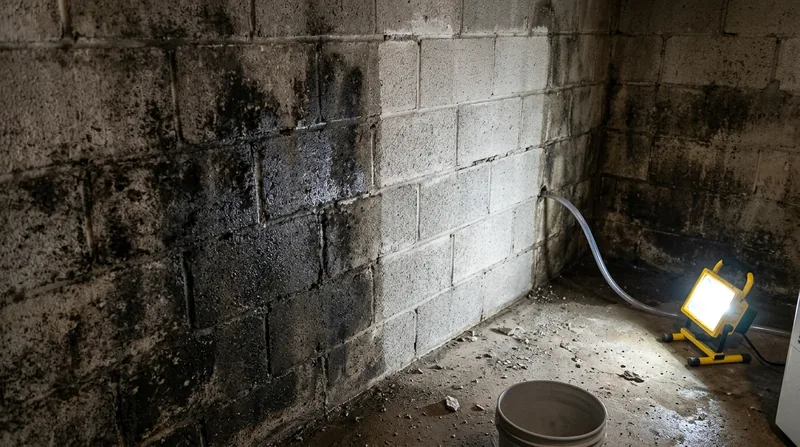




If you are dealing with Basement Mold Remediation in Des Moines, you already know the musty smell is only the symptom. The real problem is moisture finding its way through old stone and brick foundations in Sherman Hill, block walls in Beaverdale bungalows, or poured concrete in the newer Colonials out in Ankeny and Waukee. Des Moines sits on dense glacial till clay where the Des Moines and Raccoon rivers meet, and that clay holds water against your foundation long after the spring snowmelt and heavy rain have passed. We fix the moisture source first, then contain and remediate the mold growth on joists, drywall, framing, and block walls. Our work is strictly below grade and residential, from 1880s Victorians to 2020s builds. Call (515) 834-4110 to schedule a free basement inspection and a straight answer about what is actually wet. Start with our basement waterproofing page if you want the full picture on stopping water at the source.
Why Basement Mold Grows So Fast in Des Moines Homes
Des Moines basements are moisture traps by design. Old stone and brick foundations in Drake and Sherman Hill wick groundwater through mortar joints, while 1950s ranches across Merle Hay and Windsor Heights have clay-tile footing drains that have long since collapsed or silted shut. When the water table rises in the river bottoms after a wet spring, hydrostatic pressure pushes moisture through block walls and shows up as efflorescence, peeling paint, and that unmistakable musty basement smell. Mold needs only a damp surface and humid air to take hold, and Iowa summers give it both.
- Water seeps through porous block and brick walls and feeds mold growth behind drywall and insulation.
- Failed footing drains and weeping tile let water pool against the foundation instead of carrying it away.
- High humidity in finished basements across Urbandale and Johnston condenses on cool concrete and framing.
- Sump pump failure during a summer thunderstorm leaves standing water that saturates drywall and carpet within hours.
Every one of those paths leads to the same result: mold growth that returns within weeks if you only clean the surface and never correct the moisture.
Key info: A Beaverdale foursquare we inspected had efflorescence halfway up the block wall and mold on the rim joist. The clay footing drain was crushed, and the downspouts dumped right at the corner. Sealing the wall alone would have trapped the moisture inside. The fix was an interior perimeter drain and a new discharge line.
For official guidance on moisture and mold in homes, the U.S. EPA maintains a homeowner resource at epa.gov/mold. It is a useful reference, but it does not replace an on-site look at your foundation and drainage.
How We Run Basement Mold Remediation in Des Moines
We do not start with a spray bottle. We start by finding where the water is coming from, because mold remediation without moisture control is a repeat job waiting to happen. Our process combines containment, surface treatment, and the drainage or dehumidification work that keeps the basement dry afterward. That is the difference between cleaning mold and solving the problem.
- We inspect the basement, foundation walls, joists, and rim area, and we run musty smell diagnostics to locate hidden moisture.
- We set up containment with plastic sheeting and negative air pressure so spores do not spread to the rest of the house.
- We remove and bag mold-damaged drywall, insulation, and carpet that cannot be saved.
- We treat affected framing, joists, and block surfaces with an antimicrobial solution and HEPA-vacuum the area.
- We correct the moisture source, whether that means an interior drain tile system, a sump pump replacement, crack injection, or grading and downspout corrections.
- We install a vapor barrier or dimple board where the wall needs it, and we set up dehumidification for the humid Iowa summer months.
- We verify moisture readings are back to normal before we close out the job.
The goal is a dry basement and mold growth that does not come back, not a fresh coat of paint over a wet wall.
Key info: In a 1960s split-level in Pleasant Hill, mold covered the lower half of a finished wall after a sump pump failed during a July storm. We removed the drywall, treated the framing, replaced the pump, and added a battery backup so the next outage would not flood the basement again.
Remediation and Moisture Control Methods We Use
Not every basement needs the same approach. A hairline crack that seeps after rain is a different job from a wet block wall under hydrostatic pressure. The table below shows the methods we use and when each one is the right call.
| Approach | Description | Best for |
|---|---|---|
| Containment and surface treatment | Plastic sheeting, negative air pressure, HEPA vacuuming, and antimicrobial treatment of framing and block. | Visible mold growth on joists, walls, and stored contents. |
| Interior perimeter drain and sump | Interior drain tile cut into the slab, feeding a sump basin and pump that moves water out and away. | Wet block walls, hydrostatic pressure, and failed footing drains. |
| Crack injection | Epoxy or polyurethane injection through ports to seal seeping foundation cracks. | Isolated poured-concrete cracks that leak after rain. |
| Vapor barrier and dehumidification | Wall and floor vapor barrier plus controlled dehumidification for humid summer air. | Damp basements with condensation but no active seepage. |
| Sump pump replacement and battery backup | New primary pump, check valve, discharge line, and battery backup for power outages. | Failed pumps and basements that flood during storms. |
Basement Mold Remediation Cost in Des Moines: What to Expect
Basement mold remediation in Des Moines starts at From $1,500 for a contained job with limited surface treatment. That figure covers a small area of mold growth on framing or a wall section, containment, HEPA vacuuming, and antimicrobial treatment. The price climbs when the affected area is larger, when finished drywall and insulation have to come out, or when the moisture source needs real drainage work before remediation can hold.
The biggest cost driver is not the mold itself, it is the water. A basement that needs an interior drain tile system and a sump pump will land well above the base figure, while a single seeping crack with light surface mold stays near the bottom. Access matters too: a finished basement with dropped ceilings and built-ins takes longer to contain and dry than an open 1920s bungalow basement. We give you a written scope that separates remediation from the moisture fix so you can see exactly what you are paying for. For a fuller breakdown, see our pricing overview.
Get two or three estimates and compare scope, not just the number. A low bid that skips containment or leaves the drainage problem untouched will cost more the second time around.
Choosing a Basement Mold Remediation Contractor Near Me in Des Moines
Mold remediation and waterproofing are not the same trade, and the contractor you hire should be able to do both or work with someone who can. Ask for proof of liability insurance and workers compensation coverage before anyone starts, and get a certificate sent to you directly. Verify the company is a member of a trade association such as the Basement Health Association, which we are, and ask for local references from jobs in your part of the metro.
Get at least two or three written estimates that spell out containment, removal, treatment, and the moisture correction separately. Ask whether permits are required for any structural or drainage work, and confirm the rules with the local building department, since thresholds vary by jurisdiction. If you live in a neighborhood with association rules, check those before exterior work begins. For a free inspection and a clear scope, contact us or call (515) 834-4110.
Basement Mold Remediation in Des Moines: Pricing Guide
| Service | Price | Details |
|---|---|---|
| Contained surface remediation | Starting at $1,500 | Includes containment, HEPA vacuuming, and antimicrobial treatment for a small mold area. |
| Remediation with moisture correction | Starting at $2,800 | Adds crack injection or drainage fixes so mold growth does not return after treatment. |
| Full basement remediation and drain tile | On estimate | Larger finished areas and failed footing drains need an on-site look before pricing. |
| Sump pump replacement add-on | Starting at $650 | New primary pump, check valve, and discharge line installed with the remediation scope. |
| Travel | Included | In Des Moines and surrounding metro areas, no separate call-out or mileage fee. |
| Estimate | Free | Response within 24h at (515) 834-4110, no obligation to book. |
Indicative pricing, the exact cost depends on square footage, finish, and site access. Free personalized estimate within 24h at (515) 834-4110.


