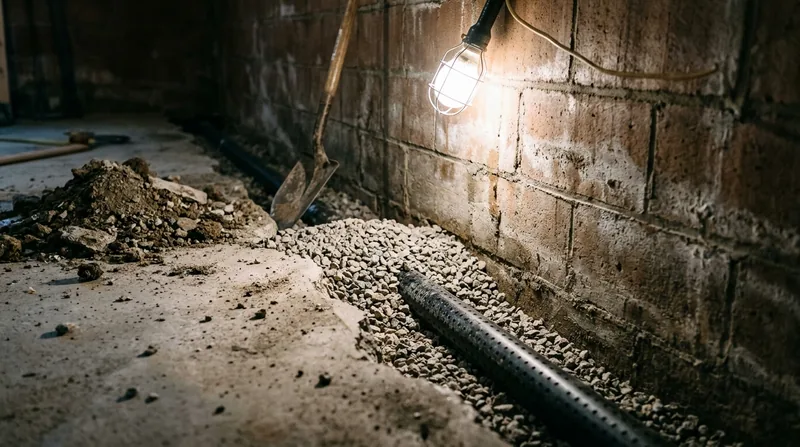




An Interior Drain Tile System in Des Moines is the below-grade answer for a wet basement that keeps coming back no matter how many times you patch the wall. The city sits on the dense glacial till clay of the Des Moines Lobe, where the Des Moines and Raccoon rivers meet, and that clay holds spring snowmelt and heavy rain against your foundation instead of letting it drain away. Homes from the 1880s brick Victorians in Sherman Hill to the 1990s Colonials out in West Des Moines and Ankeny all sit on full basements, and most of those original clay footing drains have long since collapsed or silted shut. When hydrostatic pressure builds under the slab, water finds the cove joint, the block cores, and every hairline crack in the floor. We cut the slab edge, capture that water at the footing, and channel it to a sump basin so it leaves the building instead of soaking your stored boxes and finished walls. If you want the full picture of how this fits with wall sealing and vapor control, start with our basement waterproofing service and we will tell you honestly which layer you actually need.
Why Des Moines Basements Flood and Why Interior Drain Tile Fits the Clay
The failure mode that dominates here is not a single cracked wall. It is a high water table in the river bottoms and a spring thaw that dumps weeks of meltwater onto ground that cannot absorb it. In Beaverdale and Waterbury, the 1920s and 1930s brick bungalows and foursquares were built on clay-tile footing drains that are now 80 to 100 years old. In Urbandale, Windsor Heights, and Johnston, the 1950s to 1970s ranches and split-levels often have finished basements, so the first sign of trouble is a musty smell or efflorescence on the lower block, not a visible puddle. Out in Waukee, Grimes, and Ankeny, the poured-concrete basements from the 1990s onward are tighter, but the clay still pushes water through the cove joint after a two-day summer storm.
- Water seeps over the top of the footing and pools at the slab edge because the original weeping tile is crushed or clogged with silt.
- Hydrostatic pressure forces water through block cores and mortar joints, which shows up first as white efflorescence and then as damp drywall.
- Spring snowmelt and heavy rain overwhelm a sump pit that was sized for a smaller volume than the clay actually delivers.
- Freeze-thaw cycles and frost heave open hairline cracks in the floor slab that let water wick up under carpet and tile.
An interior perimeter drain intercepts that water before it reaches the floor surface, which is why it holds up in clay where a simple crack seal does not.
Key info: A 1930s bungalow in Beaverdale with a finished basement and damp lower block is a classic interior drain tile candidate. A 2005 Colonial in Ankeny with one wet spot at a tie-rod hole usually needs only crack injection, and we will tell you so on the inspection.
Permits for work that alters drainage or the sanitary connection of a sump discharge vary by jurisdiction, so confirm the current requirement with the City of Des Moines before work starts.
How We Install an Interior Drain Tile System in Des Moines, Step by Step
We do not guess at the water source. The first hour on site is spent reading the basement: where the efflorescence sits, which wall stains are old, how the floor slab meets the footing, and whether the existing sump pit is in the low corner. On a 1940s Tudor in Salisbury Oaks, that walkthrough often shows water entering on the uphill side only, which changes where we run the drain and where the basin goes. Once the path is clear, the install is methodical and the basement stays usable the same week.
- We set up plastic sheeting and negative air to keep concrete dust out of the living space above.
- We saw-cut a channel roughly 12 inches wide along the interior perimeter of the slab, tight to the wall.
- We excavate down to the footing and remove any collapsed clay tile or debris from the old drain line.
- We lay perforated pipe in a washed-gravel bed with filter fabric so clay fines cannot clog the system later.
- We core into the sump basin at the low point and set the pit with a check valve on the discharge line.
- We pour new concrete over the channel, tie it into the existing slab, and test the system with water before we leave.
The result is a gravity-fed channel that moves water to the basin year-round, including in deep winter when the ground is frozen and exterior excavation is not practical.
Key info: On a 1960s ranch in Windsor Heights with a finished basement, we ran the drain along the north and west walls only, where the grade slopes back toward the house, and tied it into a new basin in the mechanical corner. The homeowner kept the finished side untouched.
If the discharge needs a battery backup for storm outages, pair the system with our battery backup sump pump so the basin keeps emptying when the power drops.
Interior Drain Tile Approaches We Use Across the Des Moines Metro
Not every basement gets the same channel. The right approach depends on wall material, slab condition, and how much water the clay is actually pushing. Here is how the common options compare in this market.
| Approach | Description | Best for |
|---|---|---|
| Full interior perimeter drain | Continuous channel along all interior walls, gravel bed, perforated pipe, and sump basin. | Block or clay-tile walls with water on multiple sides, common in Beaverdale and Sherman Hill. |
| Partial run to the wet wall | Drain installed only along the walls where water enters, tied into a single basin. | Ranch and split-level basements in Urbandale and Johnston with one wet side. |
| Drain plus dimple board | Interior drain combined with a dimple membrane that lets wall seepage fall to the channel. | Damp block walls with efflorescence where water weeps through the cores. |
| Drain plus new sump and backup | Full drain with a correctly sized basin, check valve, and battery backup pump. | Finished basements in Ankeny, Waukee, and West Des Moines where a power loss during a storm is the real risk. |
We size the pipe and basin to the water volume the clay actually delivers, not to a one-size template.
Interior Drain Tile System Cost in Des Moines: What to Expect
Pricing for interior drain tile starts at From $50 per linear foot, and that figure covers the cut, the gravel bed, the perforated pipe, and the concrete patch. The total moves with the linear footage, the number of corners and obstructions, whether a new sump basin is needed, and whether the basement is finished and needs careful protection. A single-wall partial run on a small ranch is at the low end; a full perimeter on a large 1920s foursquare with a finished basement sits higher. We give you a written number after the on-site inspection, not a phone guess.
Getting two or three estimates is smart in this market because the scope varies so much between companies. One contractor may quote a full perimeter when a partial run would solve the problem, and another may skip the gravel bed that keeps clay fines out of the pipe. Ask each one how they handle the discharge line and whether the price includes the sump basin. Our full pricing overview lays out the line items so you can compare apples to apples.
Interior Drain Tile System Near Me: How to Vet a Des Moines Waterproofing Contractor
You want a specialist who works below grade every week, not a general handyman who has watched a few videos. Ask for the license and insurance certificate before anyone cuts your slab, and confirm the coverage is current for the crew that will actually be in your basement. Get at least two or three written estimates with the scope spelled out, and ask for references from jobs in Des Moines, West Des Moines, or Ankeny that are at least a year old so you can hear how the system performed through a spring thaw. Check whether the company pulls the required permit when the work alters drainage or the sump discharge connection, and call the local building department if the answer is vague. If your home is in a historic district like Sherman Hill, ask about any exterior alteration rules before the crew arrives.
We are a Basement Health Association member, we carry insurance, and we will hand you the certificate on request. Reach out through our contact page to schedule the free inspection and get a straight answer on whether interior drain tile is the right fix for your basement.
Interior Drain Tile System in Des Moines: Pricing Guide
| Service | Price | Details |
|---|---|---|
| Partial interior drain run | Starting at $50/linear ft | Cut, gravel bed, perforated pipe, and concrete patch along the wet walls only. |
| Full perimeter interior drain | Starting at $50/linear ft | Continuous channel on all interior walls, tied into a new or existing sump basin. |
| Drain with new sump basin and pump | Added to linear footage | Includes basin, check valve, and discharge line; backup pump quoted separately. |
| Finished basement protection | Added to linear footage | Dust containment, floor protection, and careful reinstallation around finished walls. |
| Complex or large-scale job | On estimate | Multiple corners, obstructions, or historic-district rules need an on-site look before pricing. |
| Travel | Included | In Des Moines and surrounding metro areas, no separate call-out or mileage fee. |
Indicative pricing, the exact cost depends on square footage, finish, and site access. Free personalized estimate within 24h at (515) 834-4110.


