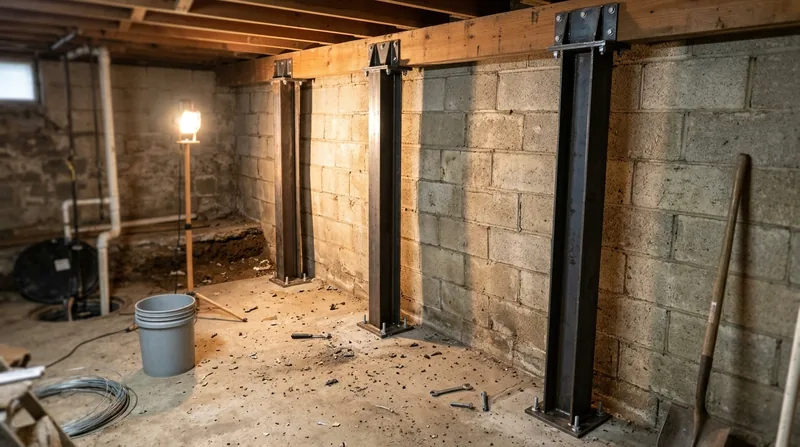




If you have noticed a Bowing Wall Repair in Des Moines problem, you are looking at one of the few foundation issues that gets worse on its own. The Des Moines Lobe left this metro sitting on dense glacial till clay, and along the Des Moines and Raccoon river bottoms the water table stays high enough to keep that clay saturated through spring. Saturated clay expands, pushes inward, and older block or clay-tile walls in Sherman Hill, Drake, and Beaverdale take the load first. Frost heave from hard freeze-thaw cycles adds a second shove every winter. We stabilize leaning and bowing walls with carbon fiber straps, steel I-beams, and wall anchors sized to the movement and your soil. Call (515) 834-4110 for a free basement inspection before the bow grows. Start with our basement waterproofing overview if you are still sorting out what is pushing the wall.
Why Bowing Walls Show Up So Often in Des Moines Basements
The building stock here explains most of it. Victorian brick and frame homes from the 1880s to 1910s sit on old stone and brick basements, and 1920s to 1940s bungalows and Beaverdale foursquares were built with block or clay-tile walls and original clay footing drains that have long since clogged. Once the footing drain stops moving water, hydrostatic pressure builds against the wall and the wall starts to move. The failure mode that dominates in Des Moines is saturated glacial clay pushing inward after spring snowmelt and heavy spring rain, with frost heave finishing the job in a hard January.
- A wall that leans inward more than about an inch over its height is moving, not settling.
- Stair-step cracks that step down a block wall usually track a horizontal shear, not a shrinkage crack.
- Doors and windows that stick on one side of the basement often mean the wall above has rotated.
- Efflorescence and white powder on the block point to water moving through the wall, which softens the mortar.
- Original clay footing drains in pre-war homes are commonly collapsed or root-filled and no longer relieve pressure.
None of those symptoms fix themselves, and sealing the inside face of a moving wall only hides the water while the clay keeps pushing.
Key info: A 1920s bungalow off Merle Hay with a block wall bowing two inches is a different repair than a 1990s poured wall in Ankeny with a single vertical crack. The first needs stabilization against clay pressure. The second may only need crack injection and drainage work. We tell you which one you have.
Structural foundation repair in Iowa is permitted work in most jurisdictions, and the local building department sets the threshold. Check the City of Des Moines permit office before any wall stabilization begins.
How We Diagnose and Stabilize a Bowing Wall in Des Moines
We do not quote a repair from a photo. A bowing wall gets measured, and the cause gets confirmed before we pick a method. On a saturated clay lot in Windsor Heights or Johnston, the wall may be moving because the footing drain is dead, because the grading sends roof water against the foundation, or because the wall itself was underbuilt for the load. The fix follows the cause, and sometimes the right answer is drainage first and stabilization second.
- We walk the basement and measure the wall plumb at several points to quantify the bow and the lean.
- We check the exterior grade, downspout extensions, and window wells for water dumping against the wall.
- We inspect the footing drain condition and look for efflorescence and moisture patterns that show where pressure is highest.
- We recommend the method: carbon fiber straps for moderate bow, steel I-beams for heavier load, wall anchors where soil pressure is the driver.
- We pull the permit where required and schedule the install around your basement use.
The goal is to stop movement and hold the wall where it is, not to straighten it back to plumb, which is rarely necessary and rarely wise on an old block wall.
Key info: A 1940s home in Beaverdale had a block wall bowing about 1.5 inches after years of a downspout dumping at the corner. We installed carbon fiber straps on the interior face and extended the downspout discharge well away from the foundation. The wall has held steady since. If your home is in Urbandale, the same approach often applies.
Repair Methods We Use and When Each One Fits
Every wall is different, and the method has to match the movement, the wall material, and the soil load. Here is how the main approaches compare on Des Moines-area basements.
| Approach | Description | Best for |
|---|---|---|
| Carbon fiber straps | Straps bonded vertically to the interior wall face to resist inward movement. | Moderate bow on block walls, minimal excavation. |
| Steel I-beams | Vertical steel beams anchored floor to joist to carry the wall load. | Heavier bow, tall walls, high clay pressure. |
| Wall anchors | Exterior anchor plates tied through the wall to interior brackets. | Walls moving from exterior soil pressure, where pulling back is possible. |
| Epoxy or polyurethane injection | Resin injected into cracks to close them and stop seepage. | Crack repair, not structural movement. |
We match the method to the measurement, and we will tell you when a crack is the only real problem and a full stabilization is overkill.
Bowing Wall Repair Cost in Des Moines: What to Expect
Bowing wall repair pricing starts from $600 for the smallest scope, typically a single localized stabilization or crack-related correction. Most real bowing wall jobs land well above that once straps, beams, or anchors are involved, because the work is sized to the linear footage of wall and the severity of the movement. The main cost drivers are the length of wall that needs support, the method chosen, whether exterior excavation is required, access to the basement, and whether drainage work has to be corrected at the same time. Getting two or three written estimates is smart here, because a wall that only needs monitoring should not be sold a full anchor system. Our full pricing overview lays out how the numbers break down.
Bowing Wall Repair Near Me: How to Vet a Contractor Around Des Moines
When you search for bowing wall repair near me, the list of names can look similar. The differences show up in the details: whether the company carries liability and workers compensation coverage, whether they will put the method and the measurement in writing, and whether they understand how Des Moines clay loads a wall. Ask for references from jobs in your part of the metro, and ask what happened to the wall two years later. Permits for structural foundation work vary by jurisdiction, so confirm who is pulling the permit and check with your local building department. If your home is in a historic district like Sherman Hill, ask about any district review before exterior work begins.
We are a Basement Health Association (BHA) member and we carry insurance on every job. Certificates are available on request. Reach us through the contact page to set up a free inspection, or call (515) 834-4110 and describe what the wall is doing.
One more thing worth knowing: if the wall is bowing because the footing drain is dead, stabilizing the wall without fixing the water source is a temporary answer. We will tell you plainly when drainage has to be part of the job, and when it can wait.
Bowing Wall Repair in Des Moines: Pricing Guide
| Service | Price | Details |
|---|---|---|
| Crack injection only (non-structural) | Starting at $600 | Epoxy or polyurethane injection on a stable crack, priced by crack length and access. |
| Carbon fiber strap stabilization | Starting at $1,200 | Interior straps on a moderate bow, priced by linear feet of wall and strap count. |
| Steel I-beam or wall anchor system | On estimate | Heavier bow and high clay load need an on-site measurement before a number is given. |
| Drainage correction alongside stabilization | On estimate | Footing drain or grading work added when water pressure is driving the movement. |
| Travel | Included | In Des Moines and surrounding areas, no separate call-out or mileage fee. |
| Estimate | Free | Response within 24h at (515) 834-4110, no obligation to book. |
Indicative pricing, the exact cost depends on square footage, finish, and site access. Free personalized estimate within 24h at (515) 834-4110.


