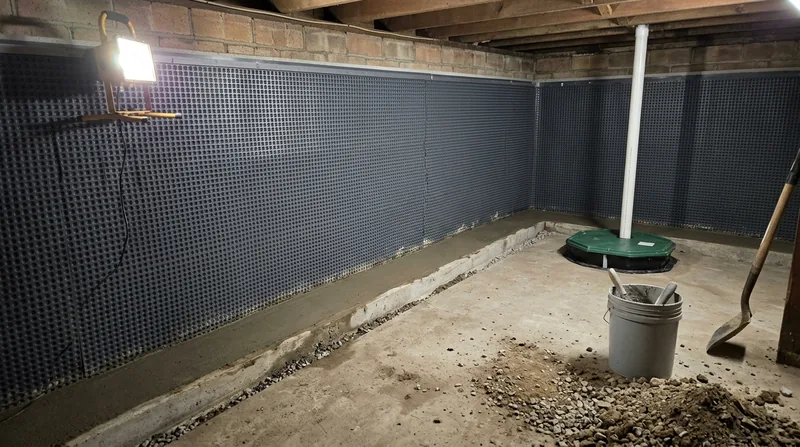




Basement Waterproofing in Des Moines: Built for Glacial Clay and River Bottoms
Basement Waterproofing in Des Moines starts with understanding what the ground under your house actually does. The city sits on dense glacial till clay where the Des Moines and Raccoon rivers meet, and that clay holds water instead of draining it. Add loess bluffs along the river valleys, a high water table in the bottoms that flooded in 1993 and 2008, and hard freeze-thaw cycles every winter, and you get the failure modes we see on every block.
Sherman Hill and Drake Victorians sit on old stone and brick basements with original clay footing drains that stopped working decades ago. Beaverdale and Waterbury bungalows show efflorescence and wall seepage after spring snowmelt. 1950s to 1970s finished basements across Merle Hay and Windsor Heights take water through floor cracks when the water table rises. Newer poured-concrete basements in West Des Moines, Ankeny, and Grimes are not immune either.
We trace the true water path before we quote anything. That means looking at grading, downspout discharge, wall construction, footing drains, and sump performance, not just the wet spot on the floor. If you want to see how we scope a job, start with a free basement inspection and we will tell you plainly what is happening.
Why Basement Waterproofing Matters So Much in Des Moines
The dominant failure mode here is not a single crack. It is hydrostatic pressure from saturated glacial clay pushing against block and clay-tile walls all spring. Snowmelt in March soaks the ground, then heavy spring rain and summer thunderstorms keep it saturated. When the water table in the river bottoms rises, water finds floor cracks, cove joints, and window wells first.
- Original clay footing drains in pre-1950 homes collapse or silt in, so water has nowhere to go but against the wall.
- Block wall cores fill with water and show efflorescence, then seep at the mortar joints.
- Clay soil expands with frost heave and opens cracks in poured walls and floor slabs.
- Downspouts that dump within three feet of the foundation recharge the same clay that is already saturated.
- Finished basements in Urbandale and Johnston hide the damage until carpet and drywall are already wet.
That is why a wet basement here is usually a drainage problem, not a paint problem. Sealing the inside of a wall without relieving the pressure just moves the water to the next weak point.
Key info: A 1920s bungalow in Beaverdale with a block wall and a dead clay footing drain will keep seeping no matter how many times the wall is patched. The fix is an interior perimeter drain that captures water at the footing and moves it to a sump basin, not another coat of sealer.
For the official word on what the city requires before you alter drainage or cut an egress opening, check the City of Des Moines permit office. Rules vary by jurisdiction, and we always confirm locally before work starts.
How We Waterproof a Des Moines Basement, Step by Step
We do not sell one system to every house. A Sherman Hill stone basement, a 1960s split-level in Windsor Heights, and a 2015 Colonial in Ankeny need different answers. The process starts with finding where the water actually enters, then building the least invasive system that solves it.
- We inspect the basement walls, floor, cove joint, window wells, and sump basin, and we check grading and downspout discharge outside.
- We identify the water source: wall seepage, floor cracks, hydrostatic pressure, a failed footing drain, or a high water table.
- We recommend the right approach, which may be interior drain tile, exterior excavation, crack injection, or simply correcting grading and downspouts.
- We install the system, tie it to a properly sized sump basin and pump with a check valve and discharge line, and test it.
- We walk you through what was done, what to watch for, and how to keep the discharge line clear through winter.
Every job ends with a wet test, not a handshake and a promise.
Local example: A foursquare in Waterbury had water crossing the floor every March. The wall was dry. The problem was a collapsed clay footing drain and a sump pit that was too small for the volume. We installed an interior perimeter drain and a larger basin, and the floor has stayed dry through two spring thaws.
Waterproofing Methods We Use and When Each One Fits
There is no single best method. The right choice depends on wall material, water source, finished vs unfinished space, and whether the problem is a crack or the whole perimeter. Here is how we match the approach to the house.
| Approach | Description | Best for |
|---|---|---|
| Interior perimeter drain | We break out a channel at the footing, install perforated pipe in gravel, and route water to a sump basin. | Hydrostatic pressure, wet floors, failed footing drains in older Des Moines homes. |
| Exterior waterproofing | We excavate to the footing, apply membrane and dimple board, and replace the drain tile. | Block walls with heavy seepage, bowing walls, and homes where exterior access is practical. |
| Crack injection | We install injection ports and seal the crack with epoxy or polyurethane. | A single poured-wall crack with no perimeter pressure, common in West Des Moines and Ankeny. |
| Wall sealing and vapor barrier | We seal masonry, parge rough walls, and install a vapor barrier and dimple board. | Damp walls, efflorescence, and musty basement smell without active water flow. |
| Sump pump and backup | We size the basin and pump, add a check valve and discharge line, and install a battery backup. | Any drained system, plus homes that lose power in summer storms. |
We tell you when simple crack sealing is enough and when the real problem is pressure that needs a drain. That honesty is why homeowners call us back.
Basement Waterproofing Cost in Des Moines: What to Expect
Most Des Moines basement waterproofing projects start at from $2,500 and go up from there. A single crack injection on a poured wall in Ankeny is at the low end. A full interior perimeter drain with a new sump basin and pump on a 1,200-square-foot block basement in Beaverdale runs considerably higher. Exterior excavation is the most expensive path because of the digging, backfill, and restoration.
Several factors move the number. The length of wall to be drained, whether the basement is finished and needs protection, the wall material (stone and clay tile are slower to work than poured concrete), the depth of the footing, and access for equipment all matter. A high water table in the river bottoms may call for a larger basin and a second pump.
Getting two or three written estimates is smart, and not just on price. Compare what is included: sump pump brand and size, discharge line routing, permit handling, and whether cleanup and hauling are in the quote. A low number that omits the pump is not a lower number. You can see our full breakdown on the pricing page before you call.
Basement Waterproofing Near Me: How to Choose a Contractor Near Des Moines
You will see plenty of names when you search for basement waterproofing near me. The differentiator is not the truck wrap. It is whether the company diagnoses the water source or just sells a system. Ask each contractor to explain what is causing your water and why their approach fits your wall type and lot.
- Confirm the company is licensed and insured, and ask for a certificate of insurance before work begins.
- Get at least two or three written estimates with a clear scope, not a verbal ballpark.
- Ask for local references from homes with your wall material and water problem, and call them.
- Ask who pulls the permit if the job alters drainage or the sump discharge connection, since thresholds vary by jurisdiction.
- Check for HOA rules on exterior excavation, discharge routing, and restoration in your subdivision.
- Verify the warranty is transferable and in writing, and read what it actually covers.
We are a Basement Health Association member, and we put our scope in writing before we start. If you want to talk through your situation, contact us and we will set up a free inspection at (515) 834-4110.
Basement Waterproofing in Des Moines: Pricing Guide
| Service | Price | Details |
|---|---|---|
| Crack injection (single poured-wall crack) | Starting at $2,500 | Includes port installation, epoxy or polyurethane injection, and cleanup; price rises with crack length and wall access. |
| Interior perimeter drain with sump basin | Starting at $4,500 | Includes channel excavation, perforated pipe, gravel, basin, pump, check valve, and discharge line to grade. |
| Exterior basement waterproofing | On estimate | Excavation, membrane, dimple board, and footing drain replacement; needs an on-site look for depth and access. |
| Sump pump replacement with battery backup | Starting at $1,200 | Includes pump sizing, basin check, check valve, discharge line, and battery backup unit; rises with basin depth. |
| Travel | Included | In Des Moines and surrounding areas, no separate call-out or mileage fee. |
| Estimate | Free | Response within 24h at (515) 834-4110, no obligation to book. |
Indicative pricing, the exact cost depends on square footage, finish, and site access. Free personalized estimate within 24h at (515) 834-4110.


