The Ground Beneath Des Moines: A Legacy of Glacial Till
If you live in Des Moines, your home sits on some of the most challenging soil in the Midwest. Thousands of years ago, the Des Moines Lobe of the Wisconsin Glacier retreated across central Iowa, leaving behind a thick blanket of glacial till. This till is a dense, unsorted mixture of clay, silt, sand, gravel, and even boulders, all packed together by the immense weight of the ice. Over time, the fine clay particles settled into layers that are incredibly tight and nearly impermeable. That might sound like a good thing for keeping water out, but the opposite is true. When rain falls on this Des Moines clay soil, it cannot soak in quickly. Instead, it runs along the surface or percolates slowly through the upper few inches until it finds a path of least resistance, and all too often, that path leads straight to your foundation wall.
What makes the Des Moines Lobe soil especially problematic is its behavior when wet. The clay minerals expand as they absorb water, then shrink and crack as they dry out. This constant cycle of swelling and shrinking puts enormous pressure on foundation walls and footing drains. It also creates deep desiccation cracks in the yard that can channel water directly down against the basement wall. Homeowners in West Des Moines and across Polk County often notice these cracks in late summer, and then find water in the basement after the next heavy rain. Understanding this soil is the first step toward protecting your home.
How Glacial Till Causes Foundation Cracks and Seepage
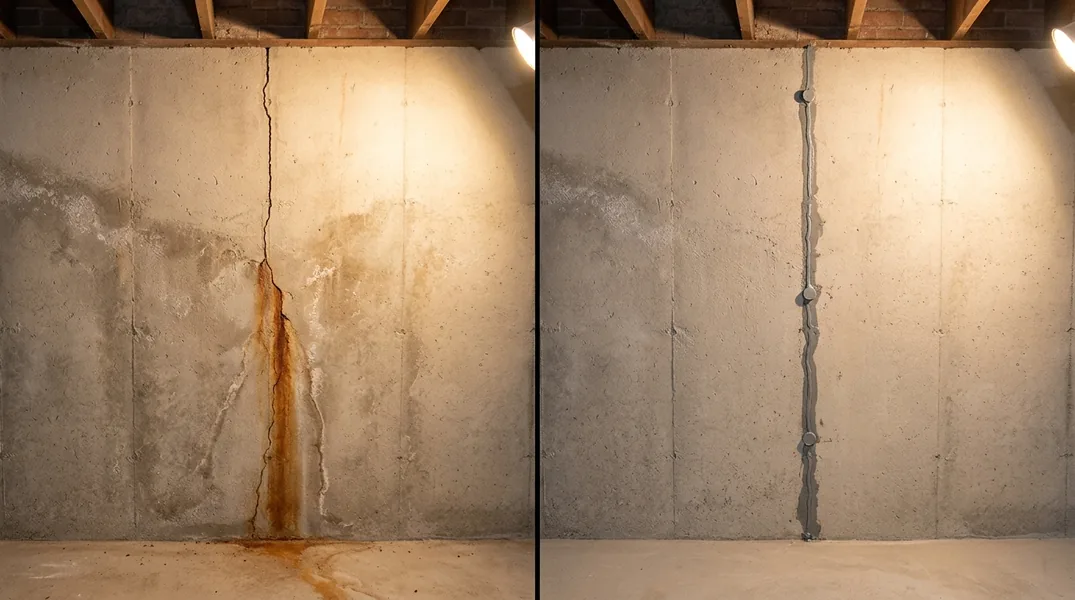
The same clay that makes Des Moines soil so fertile for farming makes it unforgiving for foundations. Because the till holds water like a sponge, the soil around your home can stay saturated for days after a storm. That saturated clay exerts hydrostatic pressure against your basement walls, pushing inward with thousands of pounds of force. Over time, this pressure can cause horizontal cracks, bowing walls, and hairline fractures in poured concrete or block foundations. These are classic glacial till foundation cracks, and they are your first warning sign that the soil is winning the battle against your foundation.
Seepage is the other major issue. Water that accumulates in the clay finds its way through the coarser seams in the till and follows the path of least resistance, which often means the gravel backfill around your foundation. If your home was built without proper drainage or if the original waterproofing has aged out, that water will enter through the cove joint where the wall meets the footing, through tie rod holes, or through cracks in the wall itself. This is what we call clay soil foundation seepage, and in Des Moines it is less a matter of if than when. The good news is that modern Foundation Waterproofing is designed specifically to handle these conditions.
Soil Movement: The Silent Force Behind Basement Leaks
One of the most overlooked causes of basement problems in central Iowa is soil movement. Glacial till does not just sit still. As the seasons change, the clay expands in wet spring weather and contracts during dry summers and freezing winters. This movement shifts the soil around your foundation, sometimes pulling it away from the wall and creating a gap that acts like a funnel for rainwater. In other cases, the expanding clay pushes against the foundation with enough force to crack even steel-reinforced concrete. Homeowners in Ankeny and other fast-growing suburbs often see this first as separation between the foundation and the driveway or sidewalk.
Soil movement also affects your drainage system. A footing drain installed decades ago may have shifted, clogged with fine clay particles, or collapsed entirely under the pressure. When that happens, water has nowhere to go but into your basement. This is why any long-term solution has to account for the soil, not just the crack. Simply patching a wall from the inside without addressing the water pressure outside is like putting a bandage on a hose. At Des Moines Waterproofing, we evaluate the soil conditions around your home and recommend a system that works with the geology of the Des Moines Lobe, not against it.
Solutions That Work With Des Moines Clay Soil
The most effective way to stop water in a clay soil environment is to manage it before it reaches the foundation. That usually means Exterior Basement Waterproofing, which involves excavating down to the footing, applying a waterproof membrane to the wall, and installing a proper drainage system that carries water away from the home. This approach addresses the hydrostatic pressure at its source and is especially valuable in areas with expansive clay. For homeowners who cannot or prefer not to excavate, an Interior Drain Tile System is a highly effective alternative. It captures water as it enters through the cove joint and directs it to a sump pump, keeping the basement dry without disturbing the exterior landscaping.
In many Des Moines homes, the best solution combines both approaches. Exterior work relieves pressure and seals the wall, while interior drainage provides a backup for any water that still finds a path through. A full Basement Waterproofing plan also includes grading the yard to slope away from the foundation, extending downspouts, and sealing cracks with flexible materials that can move with the soil. Because every home sits on a slightly different mix of till, sand, and fill, there is no one-size-fits-all answer. A professional assessment is the only way to know which system your home actually needs.
Basement Waterproofing Near Me: When to Call a Des Moines Professional
If you are searching for basement waterproofing near me in the Des Moines area, you have probably already noticed one or more warning signs: a damp smell, white powdery efflorescence on the walls, water stains on the floor, or visible cracks that seem to grow wider each year. In Urbandale and throughout Polk County, these symptoms are so common that many homeowners assume they are normal. They are not. They are signs that the soil around your foundation is doing exactly what glacial till does, and they will get worse without intervention. The earlier you address the problem, the less damage you will face, and the more affordable the fix will be.
A professional inspection will look at the soil conditions, the age and type of your foundation, the grading around your home, and any existing drainage. From there, you will get a clear recommendation and honest pricing with no pressure. If you want to understand what a solution would look like for your specific home, reach out for a free estimate or call Des Moines Waterproofing at (515) 834-4110. We know this soil, we know these homes, and we can help you keep your basement dry for the long haul.
Looking for a professional basement waterproofing contractor in Des Moines? Des Moines Waterproofing responds fast for all your basement waterproofing needs.
Get a Free QuoteOur services: Basement Waterproofing · Interior Drain Tile System · Exterior Basement Waterproofing