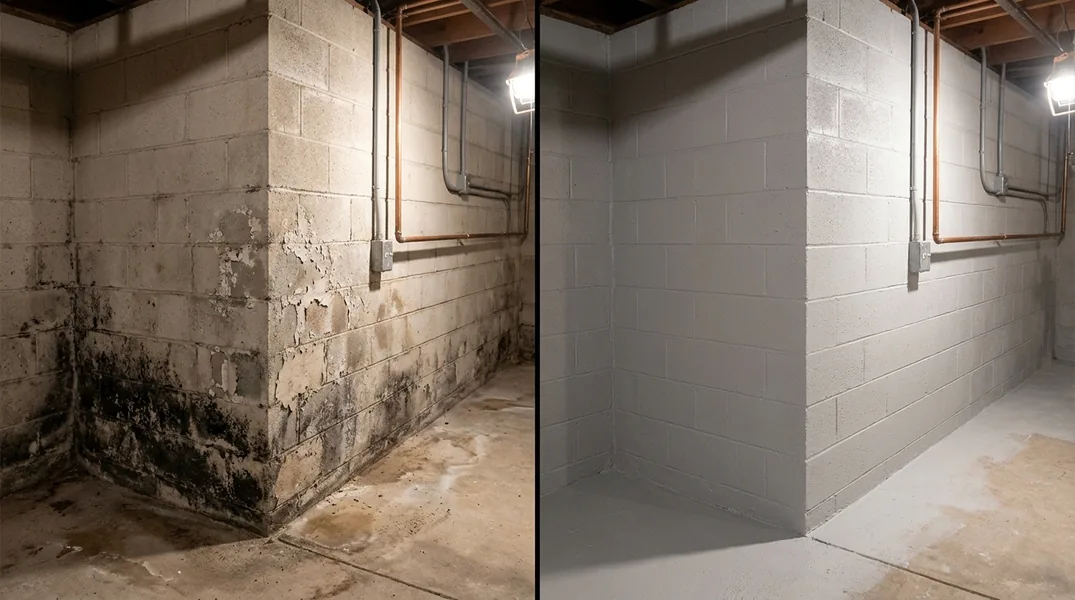
Why Des Moines Homes Face Unique Waterproofing Challenges
If you own a home in Des Moines, you already know that Iowa weather can be tough on foundations. Between the spring snowmelt, heavy summer thunderstorms, and the freeze-thaw cycles that push soil against basement walls, water intrusion is one of the most common problems local homeowners face. The clay-heavy soil found throughout central Iowa tends to hold moisture rather than drain it, which means hydrostatic pressure builds up against your foundation over time. That pressure is often the root cause of damp basements, efflorescence, and even wall cracks.
When you start researching solutions, you will quickly run into two main approaches: interior vs exterior waterproofing. Both are legitimate methods, but they work in very different ways and are suited to different situations. Understanding the difference is the first step toward making a smart decision for your home and your budget. In this article, we will break down how each system works, when it makes sense, and what to consider before you hire a contractor in the West Des Moines or Ankeny area.
How Interior Drain Tile Systems Work
An Interior Drain Tile System is installed along the inside perimeter of your basement footing. The process typically involves breaking up a narrow strip of the concrete floor, digging a trench, and laying perforated pipe that channels water to a sump pit. A sump pump then moves the water out and away from the house. The floor is patched back, and the system is often paired with a wall vapor barrier to manage humidity. Because everything happens inside, there is no need to excavate your yard, which keeps landscaping intact and often reduces the overall project timeline.
This approach is especially effective for homes where the water problem is coming from below the floor or where exterior access is limited by decks, patios, or mature trees. It also works well for finished basements because the disruption is contained. Many homeowners in Urbandale and other older neighborhoods choose interior systems when they want a reliable solution without tearing up a driveway or garden. The key is that interior systems manage water after it has entered the soil around the foundation, rather than stopping it at the wall.
How Exterior Basement Waterproofing Works
Exterior Basement Waterproofing takes the opposite approach. It involves excavating the soil around the foundation down to the footing, applying a waterproof membrane or coating to the exterior walls, and installing drainage material such as gravel and drain tile. The goal is to stop water before it ever reaches the basement wall. This method can be very effective, particularly when the foundation itself is damaged or when the problem is clearly coming through the walls rather than the floor.
However, exterior work comes with trade-offs. It is generally more invasive and more expensive because of the excavation, and it can be impractical if your home has a finished deck, a concrete patio, or extensive landscaping right against the foundation. In some cases, exterior excavation may not even be possible due to property lines or mature trees. For these reasons, exterior systems are often chosen during new construction or when a home is already undergoing major foundation repairs. For many existing homes in Des Moines, an interior solution provides better value and less disruption.
Drain Tile vs Exterior Membrane: Which Is Right for Your Home?
When comparing drain tile vs exterior membrane, the right choice depends on where the water is coming from and what you want to achieve. If your basement leaks at the cove joint (where the floor meets the wall) or you see water seeping up through cracks in the floor, an interior drain tile system is usually the most direct fix. It captures water at the point of entry and moves it away efficiently. If, on the other hand, you have bowing walls, horizontal cracks, or visible deterioration on the outside of the foundation, exterior waterproofing may be necessary to address structural issues along with water control.
It is also worth noting that the two methods are not mutually exclusive. Some homes benefit from a combination approach, especially older properties in Des Moines that have multiple points of vulnerability. A professional assessment is the only way to know for sure. During an inspection, a contractor will look at the age of the home, the type of soil, the grading around the foundation, and the specific symptoms you are seeing. That information guides the recommendation, whether it points toward interior, exterior, or a hybrid solution. You can request a free estimate to get a clear picture of what your home needs.
Basement Waterproofing Cost in Des Moines: What to Budget
Cost is naturally a major factor in this decision. Interior drain tile systems are typically less expensive than full exterior excavation because they require less labor and do not involve restoring landscaping or hardscaping. For a typical Des Moines home, interior systems often fall in a more accessible range, while exterior waterproofing can cost significantly more due to the excavation and membrane materials. However, every home is different, and factors like basement size, accessibility, and the extent of damage will affect the final number. It is always best to get a detailed, written pricing breakdown rather than relying on national averages.
Keep in mind that the cheapest option is not always the most cost-effective over time. A properly installed system that addresses the root cause will save you money on repairs, mold remediation, and energy loss down the road. If you are comparing quotes, make sure each contractor explains what is included, whether permits are needed, and what kind of warranty backs the work. A local company that understands Iowa soil and building codes is your best resource for accurate numbers and realistic expectations.
Basement Waterproofing Near Me: When to Call a Pro
If you are searching for basement waterproofing near me in the Des Moines area, you are probably noticing signs that something is wrong. Musty odors, damp walls, peeling paint, white powder on the concrete, or visible water after heavy rain are all clues that your basement needs attention. Ignoring these symptoms usually makes the problem worse and more expensive to fix. A professional can identify the source of the moisture and recommend the right system, whether that is an interior drain tile system, exterior membrane, or targeted Foundation Waterproofing.
At Des Moines Waterproofing, we help homeowners across the metro understand their options and choose a solution that fits their home and budget. We know the local soil conditions, the common failure points in older Iowa basements, and the weather patterns that drive water intrusion. If you are ready to stop guessing and get a real answer, call us at (515) 834-4110 or reach out online to schedule a free estimate. We will walk you through the comparison, answer your questions, and help you protect your home for the long haul.
Looking for a professional basement waterproofing contractor in Des Moines? Des Moines Waterproofing responds fast for all your basement waterproofing needs.
Get a Free QuoteOur services: Basement Waterproofing · Interior Drain Tile System · Exterior Basement Waterproofing